Sunday, July 30, 2017

Damage

There was a bad storm last week with very large hailstones which caused a lot of damage to the fruit.


Tuesday, October 11, 2016

Harvest 2016

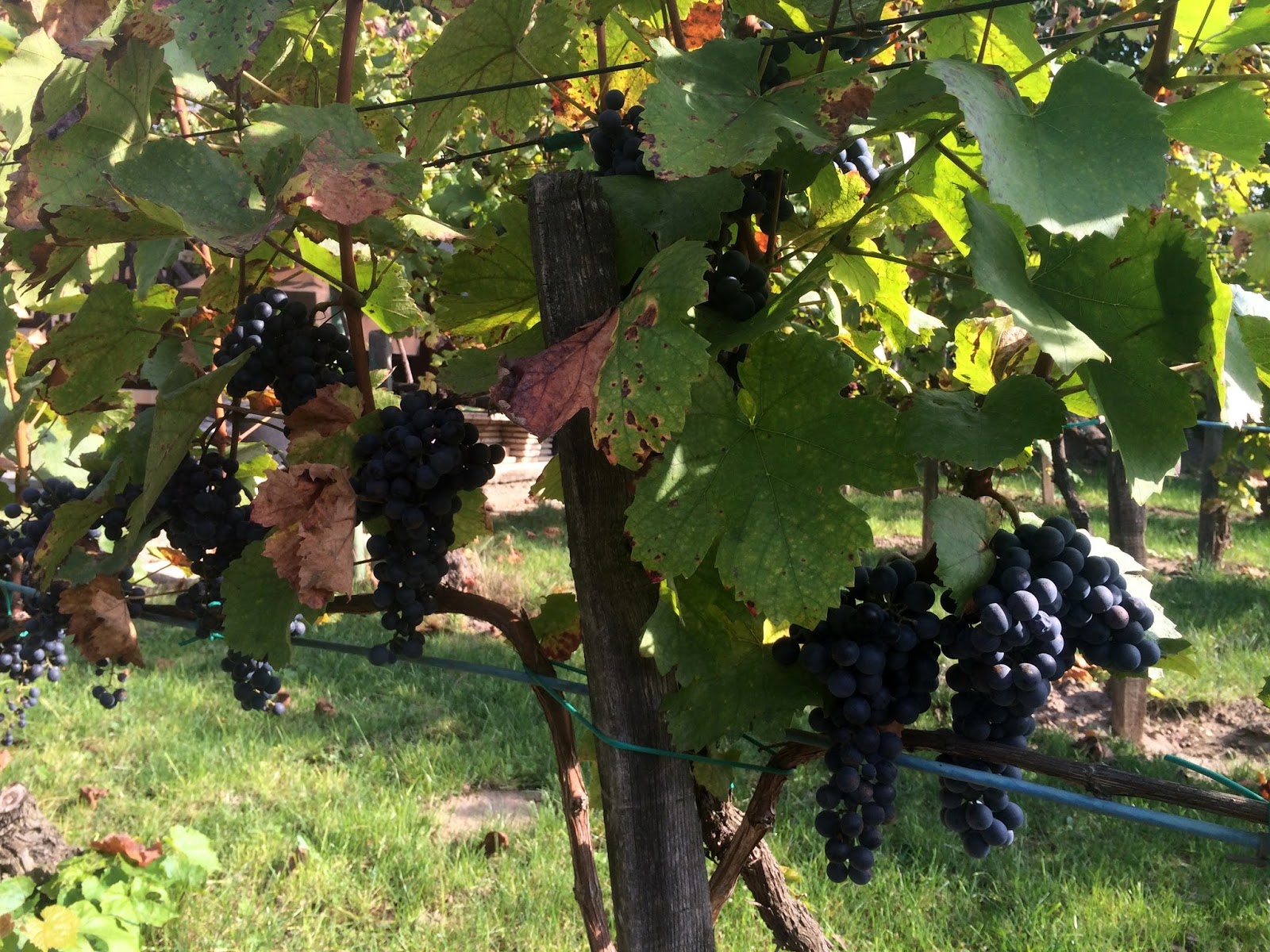
This year the white grapes were hit badly by mildew resulting from a lot of rain during a very hot July. Interestingly, only a few of the red grape vines were hit (we have a mix of Kékfrankos, Portugieser aka Kékoportó, and Zweigelt). We sold what survived from the white, and kept the red grapes for wine. They were picked 25th September. They could have stayed on the vines longer to take advantage of the Indian Summer weather, but I was available only that week.

Mainly due to time pressure - but also in order to experiment a bit - the grapes were left on the skins for just 3 days before pressing. The outcome ought to be more like a Rosé wine than a red. In total there was in the region of 75 litres after pressing. This is down from well over 100l in a good year.

The 75l was too much for one of my plastic fermentation containers so I half-filled two.  After primary fermentation, the resulting wine will be moved to an 80l barrel.

Sugar levels were quite low which is strange, after quite a hot summer and very warm September.  I hope nothing wrong with my Mustfokmérő (Must degree measurement device). Must get a spare for next time around.

And I had a little panic. After 24 hours, the juice in one of the containers appeared to be fermenting and the other one was quiet... then next morning, it was the other way round. A few days later, although I was not there, I was told both had been fermenting but one went quiet while the other was still active . This is odd. Possibly they were affected by temperature - the containers are in the Pressing House where it was warm during the day and quite cold at night. Or possibly related to the fact that one of the containers had the free-run juice, the other had the juice from pressing (although that seems a bit odd) - next time I will mix them anyhow.


Sunday, October 11, 2015

2014, 2015

I didn't post in 2014 or 2015 for a reason.

The entire crop in 2014 succumbed to Mildew.  I managed to salvage about 35-40 litres which I preserved as juice rather than make a wine.

In 2015 there was a bumper crop. Unfortunately I was working abroad and we sold it all.

Saturday, November 2, 2013

A profitable business?

At the end of the summer I started to look for a buyer for the white grapes and some of the wine in the cellar. This year we decided to make wine only with the red grapes as it's a lot of work with both the white and red, and the red on it's own should deliver more than enough wine for my own use. Meanwhile, most of the barrels were already full with previous year's wine, and I didn't know what to do with them.

In the end I sold 300 litres of white from 2011 and 2012, and 250 kg of white grapes. Not for a great deal of money, and if I was to calculate how much I invested in the work to grow and harvest them, it would hardly be profitable. Still, I must say I had a proud feeling, selling my wine for real hard cash!

So this year we harvested and pressed only the red grapes, resulting in about 110-120 litres which after the first racking should nicely fill a 100l barrel.  Unfortunately the red wine from the past two years has gone slightly vinegary, one reason can be too much air in those barrels as the quantity of the wine did not fill them completely.  In future I will make sure the barrels are full, and also to mix in some sulphur at each racking to kill off harmful bacteria.

The wine which has gone off can be converted to Pálinka, so this is under consideration!


Monday, August 12, 2013

Barrel Refurbishment

A few weeks ago we took all the barrels up from the cellar, washed them down, painted the rings and put sunflower oil on the wood.  They look great now.


Thursday, August 8, 2013

British wine-making in the good old days

Click on the picture for video. Nice wholesome fun.


Wednesday, August 7, 2013

Mushrooms in the cellar

(This was a post from 2010 which I never published at the time.)

Check this out!!!  Mushrooms growing in the cellar!

Must be all the rain this year. There is also a lot of fungus on the barrels.


Sunday, April 8, 2012

Reusing Bottles

Ever since I bottled the 2009 red, I belatedly realize that is worth saving wine bottles. Otherwise I need to pay around 120-130 Forints for new ones. That's about 45 Eurocents each. Multiply that by say 100 bottles, and it's a chunk of money.

Although I don't even drink all that much wine, I've now got around 120 bottles in the cellar, cleaned and waiting to be filled.  Plus a dozen or two more, waiting to be cleaned.


On the other hand, cleaning the damn things is labour-intensive and boring. First you need to get the collars and labels off. While many labels come off easily with soaking in hot water, some are stuck with some industrial super-glue that needs heavy duty treatment. Once in a while I fill the bath with piping hot water, dump in 20 or 30 bottles, and after a while, go to work to remove the labels.

Ah, but that's just step 1. They still need to be sterilized, this time with a solution of sodium metabisulphite in cold water.


And now, they need to dry out. This is harder than it sounds. Glass bottles stubbornly resist drying-out, in any kind of weather.  My technique is to leave them upside down for the best part of a day to let most of the water drip out; then I turn them right-way up, cover with sheets of kitchen paper weighted down a little so they don't blow off (the kitchen paper keeps out insects and dust), leave them in the summer house until the next time we visit - by then they will be dry. Finally I stopper them up with a rolled up wad of kitchen paper, put them in boxes and bring to the cellar.

The first batch I bottled, I didn't do any of this. I simply rinsed them out, let them drip up-side down for a couple of hours, then filled them up.  This is all completely against the book!  If they are not sterilized, bacteria and microbes can remain, ready to attack the wine - so sayeth the book. However, I'm not sure it made much difference at all. While a couple of the bottles went bad (the wine fizzed up when I pulled out the cork, and it tasted bad), there can be various reasons for this, and 95% were fine.

Similar goes for all the equipment we use - buckets, etc.  Theoretically it should all be sterilized, but in practice it would add an awful lot of time to the work.  It seems the average "man in the street" around here doesn't bother - in fact, I get strange looks if I propose sterilizing the equipment!

Racking, Decanting, First Buds

On Friday this Easter weekend we racked the 2011 wines. The weather forecast for the weekend was for cold and wet. Since a lot of equipment must be washed and dried, a warmer dry day is best. Luckily, on Friday morning it was still pleasant, and the rain only started later in the day.  By today, Sunday, the cellar (8 degrees) is already warmer than outside!


We didn't rack the 2009 barrel of white, mainly to save time, and anyway it has been racked a number of times before.  It took around 3.5 hours to do the 2011 wines.

Most important, I got a chance to taste them!


The red has no bad flavours, but it really hasn't developed any character at all yet.  After racking, there is around 75l.

The white in the large barrel tastes quite balanced, not as acidic as the 2009 white. We have about 150l of it.

There is also a smaller barrel of white which was from the second pressing, and Sándor says not enough sugar was added. This one definitely doesn't taste as good as the other white, the difference is quite marked, even though I don't have a particularly strong sense of taste (and even less of smell). There's about 40l of this one.


Finally, I had a small quantity of white which the girls pressed by foot, from the first batch of grapes to ripen, the Muscately variety. This has been in a glass carboy, or ballon, so I could have a bit more visibility to the process.  After taking out the wine to clean out the lees, I decided to bottle most of it, rather than wait for the carboy to dry out, as the day was getting colder.  I filled 11 bottles with the amount siphoned out first, which was clearest. A remaining few litres from nearer the bottom of the carboy went into the smaller barrel of white.  This one is a pale colour and a bit acidic, okay for fröccs (spritzer).  Doesn't seem to be much sediment in the bottles but let's see after it settles for a while.


In the 2009 reds and whites we bottled in 2010, there is a significant amount of sediment in the bottles. In the case of the red, it's not very noticeable. But the whites are in clear bottles and it looks rather ugly and off-putting.

Which leads to the subject of decanting wines. Until recently I would happily drink wine from the bottle, but with my own wines I always decant them.  Historically, wines were decanted as much for reasons of sediment in the bottles, as of flavour and appearance.  Nowadays, commercial wines are usually cleared and filtered so that there is no sediment (although I have seen sediment in some Hungarian commercial wines.)  When I decant my wine, I slowly removing the cork without disturbing the contents of the bottle, and pour gently so that in the end a few mm of sediment remains in the bottle.  As well as not separating the sediment,  the flavour of the red develops greatly with a lengthy period of time to breathe (at least 30 minutes, but even next day it tastes good without being stoppered overnight), and also adjust to room temperature if it came directly from the cellar.

Last and not least, the vines were pruned a few weeks ago and growth starts to appear. The weather forecast for tonight is below zero... hopefully frost will not damage the vines and other fruit trees.


Tuesday, November 1, 2011

After pressing the red grapes I took away a small bottle of the juice.  Already with only 2 weeks in the vat the primary fermentation - where the yeasts turn most of the sugar into alcohol - was complete, more or less.
The secondary fermentation - where bacteria turn most of the remaining sugar into alcohol - will continue slowly.

The taste of the juice was of wine, but very "raw".  After a day or two, I poured off the clear wine from the bottle into one glass, and the "lees" at the bottom of the bottle into another glass. The contrast is clear. This lees consists of sediment from the grapes as well as dead yeast cells.


This is an example of what is in the barrel at the moment.  The lees tasted more or less the same, but didn't look very appetising!

This week we will rack the white, maybe the red too.


Wednesday, October 19, 2011

Some pictures from the red grape pressing

The red grapes (actually some white too) had sat in the vat for 2 weeks to macerate (get the colour out from the skins).  Early on a cold sunday morning we pressed them.


The vat had been covered to keep off the fruit flies...


The partly crushed grapes float to the top. Every day the "cap" needs to be pushed down so the oxygen can get at the juice and help it ferment. After 2 weeks the primary fermentation is mostly complete and most of the sugar will have already turned to alcohol.


All the grapes are thrown in the press and the screw is turned. This press is a bit too big for a quantity of only about 100l.


The trick is to turn the screw so it won't easily go further, wait a minute, then it is possible to turn it again... and repeat for the best part of an hour.


When it doesn't seem practical to keep pressing, dismantle the press and remove the cake of grapes.  In fact they are still a bit juicy and if there was a large enough quantity it would be worth pressing them again. 


The pressed grapes get thrown back onto the soil...


And finally the barrel is (almost) full. About 90l in this case. After racking a few times it might end up about 70l. The first racking will be later in the year.


Wednesday, October 12, 2011

Harvest

After a disastrous 2010 when we made no wine at all, this year things got back on track.
The quantity is about half of 2009. Let's hope quality wins over quality!

During September and October we had three separate grape picking occasions.


At the very start of September, the Muscately grapes were already ripe and the wasps were starting to eat them. As there was only a small quantity, the girls pressed them by foot and we squeezed the remaining juice out by hand. Slow work. As we started in the afternoon, it went on into the very warm evening.  The must was very sweet, about 19 degrees sugar. It was only about 30 litres, so I used a 50l plastic container, and added a small amount of sugar - about 800g - to bring it up to the desired 21 degrees - the ideal level for starting the fermentation, which should result in a wine around 12.5 degrees of alcohol.


Having covered it to keep off the fruit flies, it sat - with occasional stirring - for a couple of weeks before it was racked into a 25l glass 'carboy' jar.  This year I wanted to make a small quantity of wine separately from the rest, and store it in glass, so the process is more visible.  The problem with storing it in a barrel, is that during the time when it ferments and settles, it isn't possible to see the separation of the clear wine and the 'lees' which float to the bottom (dead yeast, dead bacterial microbes, and other gunk). And it means that racking off the clear wine without disturbing the lees is more difficult. Finally, by keeping a small amount of wine separate, it will be interesting to compare the eventual taste of the wine versus the main bulk.


Then in mid-September the bulk of the white grapes were picked and pressed a few days later.  This year it resulted in only about 250litres compared with nearly 500l two years ago.  I'm not complaining too much. Most of the white from two years ago is still sitting in a barrel (although much less than the original 500l after multiple racking). This must was 18 degrees, to which 8kg of sugar was added.  These are currently sitting in two barrels a little over 100l each, until they will have their first racking in November.


And finally, a week ago, we picked the red grapes. There wasn't enough quantity to setup the machine which takes off the stems, and we had enough labour to do that by hand, since we were celebrating  Györgyi's 40th birthday that day.


The lightly-crushed red grapes are currently sitting in a large vat for 2 weeks. Unlike the white wine, to produce a red wine, they have to sit and macerate for 2-3 weeks before the pressing - this means the colour needs to come out of the skins.  If they are pressed a few days after picking - like the white grapes - a rosé will be the result. On the coming weekend we will press them.  My estimate is about 100 litres.  Actually we mixed in white grapes from Györgyi's mother's garden.  Otherwise it would have been only around 50 litres. Two years ago we had 100l from the red grapes alone.  The red must was 17 degrees, to which 450kg of sugar was added.


In the next posts, I plan to write about the books I've been reading about winemaking and how they are starting to influence my thinking about how I want to make the wine in future.